

Homeschool and Classroom
Best Homeschool Workbooks for Elementary Daily Practice
The best homeschool workbook is the one that matches one current skill gap and fits a routine your child can repeat. Choose by subject, readiness, and practice format—not by buying the biggest bundle.
Browse Scholastic Panda Education books by subject, then use the checks below to choose one practice resource.
Choose by the decision you need to make
| If your learner needs… | Start with… | Check before buying |
|---|---|---|
| More automatic multiplication recall | A multiplication speed-drill workbook | The child understands the facts before timing begins. |
| A predictable spelling routine | A grade-matched weekly spelling workbook | The word difficulty and phonics work fit the learner. |
| More readable everyday writing | A handwriting workbook with short copy practice | The page style and print size are comfortable. |
| Early pencil, letter, and number practice | A preschool-readiness or tracing workbook | The child can work briefly without hand fatigue. |
What makes a workbook useful for homeschool?
A useful homeschool workbook solves a defined practice problem. It gives the adult a clear starting point, keeps the page format predictable, and provides enough repetition to revisit a skill without assembling new worksheets every day. It should support instruction rather than replace explanation, conversation, reading aloud, hands-on work, or feedback.
Before choosing a book, write one sentence that begins, “My child needs practice with…” A narrow answer such as “multiplication facts through 12,” “weekly third-grade spelling words,” or “forming letters with consistent spacing” is actionable. “Needs a complete elementary curriculum” is too broad for one practice workbook.
Match the workbook to the learner
Grade labels are a useful first filter, but readiness is the better final test. Preview the skill named in the book title and ask whether the learner can complete an easier example with limited help. If every item requires reteaching, the material is probably too difficult for independent daily practice. If the learner can finish without thinking or checking, it may be too easy.
- Buy now when the skill is already taught, practice is the missing piece, and the format matches the learner.
- Adapt the routine when the book fits but a full page is too much; assign a smaller set and review it immediately.
- Wait or choose something else when the learner still needs direct instruction, concrete examples, or a different level.
Try one example before choosing a subject
Suppose a third grader can show 6 × 4 as six groups of four but counts every group again to find 24. A multiplication practice book is a reasonable option to compare. If the child cannot explain the groups, model the idea with counters before assigning independent facts. For spelling, ask the learner to write three words from the current lesson and use one in a sentence. For handwriting, have the learner copy that sentence and check whether the letters and spaces are readable.
These are suggested checks you can try on plain paper, not pages from the books below. Choose the area that needs practice with the least reteaching, and keep direct instruction alongside it.
Four Scholastic Panda Education paths
1. Multiplication facts for grades 3-5
Multiplication Speed Drills is a fit when a learner understands multiplication but needs repeated facts 0-12 practice. Begin untimed and use speed only after answers are accurate and calm. If multiplication and division are both familiar, compare the separate and mixed options in our math fact fluency workbook guide.

Multiplication Speed Drills
Consider this for grades 3-5 multiplication-fact repetition after the learner understands the facts. Start untimed and track accuracy before speed.
2. Weekly spelling for elementary learners
A weekly spelling workbook can reduce planning when a learner benefits from a repeated word-study rhythm. Choose the grade band from actual word difficulty, not age alone. Scholastic Panda Education has verified catalog options for grades 1-2, grade 3, and grade 4. Parents comparing the middle option can use our third-grade spelling workbook guide.

Spelling Weekly Practice for 3rd Grade
Consider this when an elementary learner needs a structured third-grade spelling and vocabulary practice routine.
3. Handwriting practice for ages 6-8
Handwriting Practice Book for Kids Silly Sentences is designed around penmanship practice for kindergarten through third grade and ages 6-8. It may suit a learner who can form letters but needs more practice with readable writing. If the problem is rushing, faint writing, or inconsistent spacing, first read our penmanship practice guide and shorten the assignment as needed.

Handwriting Practice Book for Kids Silly Sentences
Consider this for short print-handwriting practice when the learner already knows basic letter formation.
4. Preschool readiness and tracing
For a younger learner, choose between a broad readiness book and a more focused tracing book. Preschool Easy Learning Activity Workbook covers preschool prep, pre-writing, pre-reading, and alphabet tracing according to its verified listing. Learn to Write Tracing Letters & Numbers is the narrower choice when pen control, letters, and numbers are the main goal. See the letters-and-numbers readiness plan before deciding how much practice to assign.
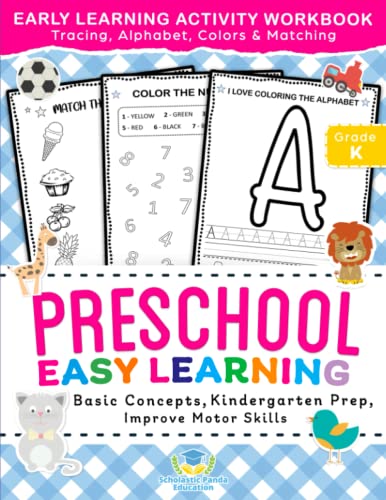
Preschool Easy Learning Activity Workbook
Consider this when a preschool learner needs a broader mix of short readiness, pre-writing, pre-reading, and tracing activities.
A simple 15-minute daily workbook routine
- Name the target (1 minute). Say exactly what today’s page practices.
- Model one item (2 minutes). Work one example together and explain the check.
- Practice a small set (8 minutes). Stop at a natural point rather than forcing a full page.
- Correct together (3 minutes). Rework one error pattern while it is fresh.
- Record the next step (1 minute). Note whether to repeat, continue, or return to instruction.
Treat these times as a sample plan, and shorten any step to fit the learner. You could use it for morning work or an after-lunch practice block. At the next review, look for changes in prompting, repeated errors, and the learner’s explanation of the skill. Those observations can help you adjust the assignment; page count alone does not show what the child understands.
How many workbooks should you use at once?
Consider starting with one active practice book and adding a second only if it fits your schedule. A simple schedule might alternate math and spelling, with handwriting used two or three times per week. Preschool learners may need even shorter sessions and more play, conversation, movement, and hands-on practice between pages.
Adding books too quickly makes it harder to tell what is working. Use one resource consistently for a short review period, then ask: Is the level right? Can the learner begin with less help? Are the same errors decreasing? Keep, adapt, or replace the book based on those observations.
Common workbook-buying mistakes
- Choosing a bundle before identifying the learner’s actual practice gap.
- Assuming the printed grade automatically guarantees the right difficulty.
- Starting timed work before the learner can answer accurately.
- Assigning every problem when a smaller set would leave time to discuss and correct errors.
- Using independent pages when the child still needs teaching and examples.
- Switching resources before a consistent routine has had time to settle.
Sources and limits of this comparison
Book titles, stated grade or age ranges, and covers were checked against Amazon catalog information retrieved July 30, 2026. The four linked listings are Multiplication Speed Drills (1953149359), Spelling Weekly Practice for 3rd Grade (1953149456), Handwriting Practice Book for Kids Silly Sentences (1953149421), and Preschool Easy Learning Activity Workbook (1953149308). The tracing alternative is Learn to Write Tracing Letters & Numbers (1953149316). This is a comparison of the named practice options, not a ranking of every homeschool workbook. We have not reviewed the book interiors for this guide; the sample checks and routine above are suggestions, not verified book activities or promises of results. Check the linked listings for current details and any available previews before buying.
FAQ
What are the best homeschool workbooks for elementary students?
The best choice matches one current skill gap, the learner’s readiness, and a repeatable schedule. Choose a subject-specific book for math facts, spelling, handwriting, or preschool readiness instead of expecting one workbook to cover a full curriculum.
How long should elementary workbook practice take?
Start with about 10-15 minutes, including one modeled example and immediate correction. Shorter work is appropriate when attention, hand fatigue, or frustration begins to reduce the quality of practice.
Should homeschool parents use a workbook every day?
Not necessarily. Use it often enough to create a predictable routine, but combine workbook practice with instruction, reading, discussion, movement, and hands-on learning.
How do I know whether a workbook is too hard?
If the learner needs adult rescue for most items, cannot explain an easier example, or repeatedly guesses, return to instruction or choose an easier level before assigning independent pages.