
Book Spotlights: Daily Practice Workbooks
High-Frequency Words for Kindergarten: A Sight Word Workbook Guide
For kindergarten and early first grade, choose high-frequency-word practice that combines quick recognition with attention to sounds and spelling. This workbook is a practical fit when a child already knows some letters and sounds and needs a short, repeatable way to read and write common words—not just memorize a long list.

Is this the right kind of practice?
| What you notice | Best next step | Workbook fit |
|---|---|---|
| The child recognizes letters and can connect at least some sounds to print. | Practice a few common words while pointing out the regular and less predictable letter-sound parts. | Good fit with brief adult guidance. |
| The child reads a word today but forgets it tomorrow. | Repeat the same small word set across reading, spelling, and a short sentence. | Good fit if pages are revisited. |
| The child guesses from the first letter or picture. | Slow down, look through the whole word, and connect the spoken sounds to the printed letters. | Use selectively; do not reward guessing. |
| Most letter names and sounds are still unfamiliar. | Build alphabet and sound knowledge first, then add only a few useful words. | Save the full workbook for later. |
| The child becomes frustrated by a long list. | Cover the rest of the page and practice two or three words without timing. | Adapt the page or pause. |
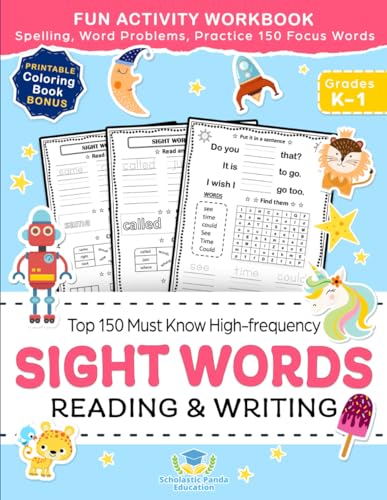
Sight Words Top 150 Must Know High-Frequency Words
Consider this workbook if your kindergarten or early first-grade learner needs structured practice reading and writing common words. Preview the Amazon listing to confirm that the format and level fit your learner.
What “high-frequency words” and “sight words” mean
High-frequency words are words that appear often in children’s text. A sight word is any word a reader can recognize automatically. The terms overlap, but they are not identical: a child can eventually recognize a regular word by sight after successfully reading it enough times.
That distinction changes the practice decision. Children should not be asked to memorize every common word as an unexplained visual shape. Many words contain spellings they can sound out completely or partly. Help the learner connect speech sounds to letters, then practice until recognition becomes quicker.
For a fuller comparison, read Sight Words vs. High-Frequency Words. If you are deciding between named lists, use the Fry words vs. Dolch words guide.
A 10-minute practice routine
- Review for two minutes. Show three to five previously practiced words. Put any missed word back into today’s set.
- Map one word for two minutes. Say the word slowly. Ask the child to identify the sounds they hear, then point to the letters that represent those sounds. Briefly explain any part that is less predictable.
- Read for two minutes. Place the target word in a short phrase or sentence. Ask the child to read through the whole line instead of naming the word in isolation only.
- Write for two minutes. Say the word, have the child repeat it, then write it from memory. Compare the attempt with the printed word and correct it calmly.
- Close for two minutes. Mix today’s word with two known words. End after a successful read or correction and note which word should return next time.
This routine can work at home, in a homeschool block, during a literacy center, or in a short intervention group. The useful measure is not how many pages were finished. Watch whether the learner reads the same words more accurately in phrases and can spell or build them with less help.
Practical examples for kindergarten words
Suppose the target word is the. Say the word, stretch the sounds as clearly as possible, and look at each letter. Explain that the first two letters work together in this word. Then use it in phrases such as “the cat” and “the red hat.” Ask the child to write the, check all three letters, and read one phrase again.
For a more regular word such as in, let the child use known letter sounds to read it. Blend the sounds, read “in the box,” and write the word from dictation. This helps the child see that many frequently used words can be read through phonics rather than memorized as pictures.
Keep examples appropriate to the words the learner is encountering in instruction and books. A fixed list can provide order, but it should not replace reading connected text, learning phonics, or receiving feedback from an adult.
How many words should a child practice?
Start with three to five words in one session, including review words. Add a new word only when the current set is manageable. A child who needs more prompting may benefit from two words; a child who reads the set accurately in short sentences may be ready for another.
There is no need to race toward all 150 words. The number in a workbook title describes the collection, not a daily goal or a universal kindergarten requirement. Schools and curricula introduce words in different orders. Match the workbook to the learner’s current instruction where possible.
When to buy, adapt, or skip this workbook
- Consider it when you want an organized bank of common-word practice and can provide brief modeling and correction.
- Adapt it when a full page feels crowded. Cover unused items, select a smaller set, remove timing, and revisit earlier pages.
- Skip it for now when the child needs foundational letter-sound instruction, or when their teacher has supplied a sequence that should remain the primary plan.
- Ask for guidance when reading remains persistently difficult despite appropriate teaching and practice. A workbook is a support tool, not an assessment or a substitute for individualized instruction.
Related next steps
Parents beginning with a new reader can use the kindergarten sight word practice routine. To understand why sound-to-letter connections matter, see Orthographic Mapping for Parents. Teachers and families comparing card practice can also review the kindergarten sight word flash-card guide.
FAQ
What are high-frequency words for kindergarten?
They are common words that young readers encounter often. The exact kindergarten set and teaching order vary by school or curriculum, so practice should follow the learner’s current instruction when possible.
Are high-frequency words the same as sight words?
Not exactly. High-frequency describes how often a word appears; sight word describes a word a particular reader recognizes automatically. With successful practice, many words—including phonically regular ones—can become sight words.
Should children memorize sight words by shape?
Practice should connect the spoken word’s sounds with its printed letters. Some common words include less predictable spellings that need a short explanation, but children should still look through the whole word rather than guess from its shape.
How long should kindergarten sight word practice take?
About five to ten focused minutes can be enough for a small word set. Stop or reduce the set if the child begins guessing, rushing, or becoming frustrated.