Handwriting and Cursive
Choose a silly-sentence handwriting book when a child can already form most print letters but needs steadier spacing, letter size, and sentence-copying practice. If letter formation itself is still difficult, start with tracing or single-letter practice instead.
Is sentence practice the right next step?
| What you notice | Best next practice | Workbook decision |
|---|---|---|
| Many letters are formed backward or from an awkward starting point | Model and trace individual letters | Wait on sentence-heavy practice |
| Letters are recognizable, but size and spacing vary | Copy one short sentence with a single focus | A sentence workbook may fit |
| Writing starts neatly and becomes hard to read | Shorten the amount and add a movement break | Adapt the page rather than requiring completion |
| Copying is neat, but independent sentences are difficult | Say and build the sentence before writing it | Combine copying with a brief original sentence |
What to check before buying a handwriting practice book
Start with the child’s current writing, not a grade label. Ask the child to copy a simple sentence such as The red fox naps. Then look at four features: whether letters sit on the line, lowercase letters are a similar size, spaces separate words, and the child can finish without hand fatigue or frustration.
A sentence-based workbook is a reasonable match when the child can form the letters and the main problem is consistency. It is not the best first tool for a child who still needs direct help with pencil grasp, basic strokes, or how each letter begins. For that stage, use the letters-and-numbers readiness plan.

Handwriting Practice Book for Kids Silly Sentences
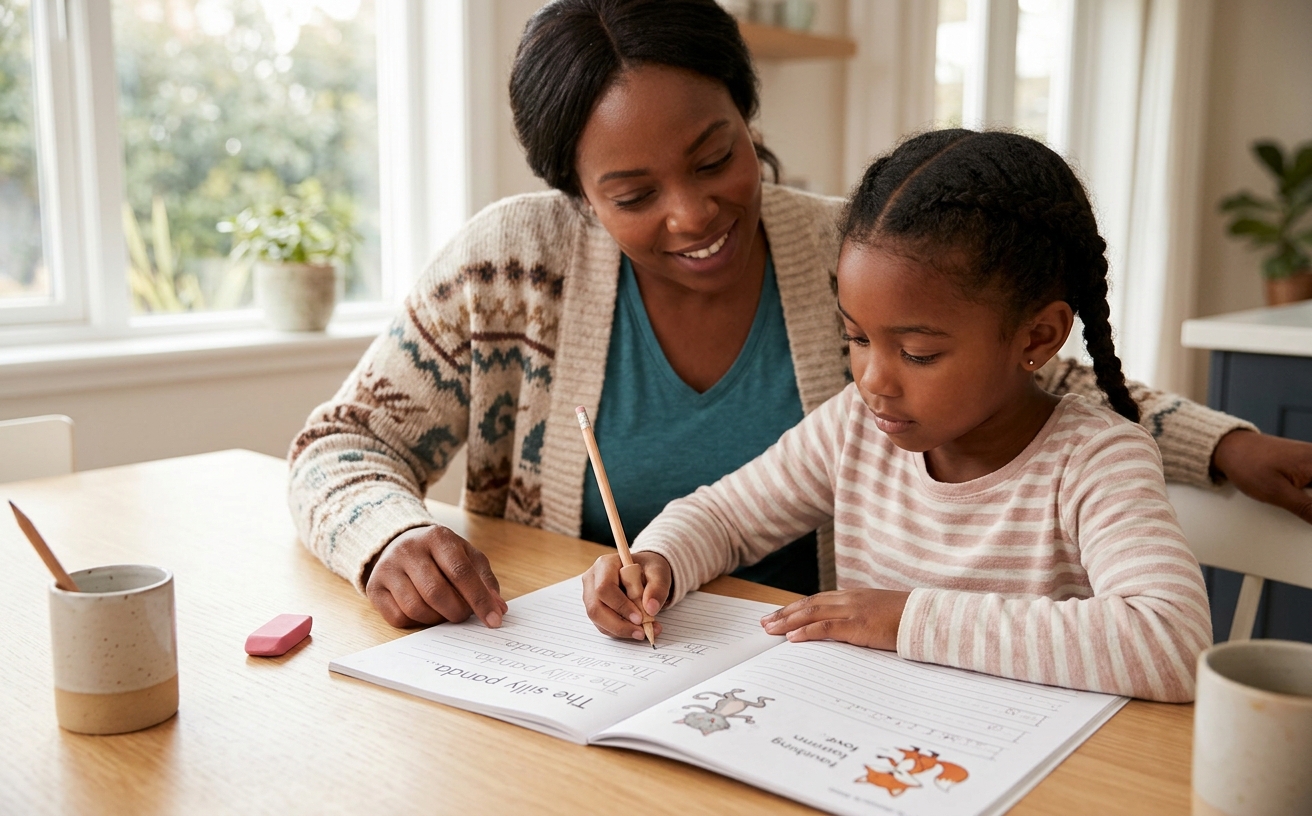
Consider this Scholastic Panda Education workbook when the learner already forms most print letters and needs structured sentence-copying practice. The Amazon listing identifies it for kindergarten through 3rd-grade handwriting practice; match the task to the child’s current skill rather than age alone.
Use a 10-minute handwriting routine
- Choose one target. Pick spacing, letter size, line placement, or careful copying—not all four at once.
- Preview the sentence. Read it aloud and point out one feature to watch. For Six ducks sing softly, you might notice the spaces between four short words.
- Model a small part. Write the first word while describing where letters begin and where they sit.
- Copy one sentence. Cover the rest of the page if a full page looks overwhelming.
- Circle one success. Mark the clearest word or best space. Correct one repeated pattern, then finish.
For classroom use, place one sentence at a handwriting station and keep the same target for several sessions. At home, three or four short practices can be easier to repeat than one long weekly session. The useful measure is controlled, readable writing—not how quickly a page is completed.
Why silly sentences can help
A playful sentence gives the child meaning to hold while practicing mechanics. Compare copying isolated words such as cat, hat, mat with copying A cat wears a blue hat. Both provide letter practice, but the sentence also requires word spacing, capitalization, and an ending mark.
The humor does not teach letter formation by itself. Its job is to make repetition less monotonous. Keep the handwriting goal explicit: “Today we are making spaces wide enough to see” is more actionable than “Write neatly.”
Adapt the practice for common problems
| Problem | Simple adaptation | What to review |
|---|---|---|
| Words run together | Place a finger or craft stick after each word | Are spaces visible without becoming too wide? |
| Letters float above the line | Highlight the baseline before writing | Do most letters touch it? |
| Letter size changes | Practice only one short phrase | Are the lowercase bodies similar in height? |
| The child rushes | Remove any speed goal and cover later lines | Is the first sentence controlled? |
| The hand tires | Write fewer words and pause for movement | Does legibility stay stable? |
Use, adapt, or wait
- Use it now if letters are mostly recognizable and the child needs repeated work with spacing, size, and complete sentences.
- Adapt it if a full line is too much. Copy half a sentence, alternate words with an adult, or focus on only the clearest line.
- Wait if individual letter formation is not yet stable or writing causes pain. Return to shorter pre-writing or letter-level tasks and seek appropriate support if pain persists.
How to track progress without grading every letter
Date one sample each week and compare the same feature across samples. For example, count how many word boundaries are easy to see, or compare whether lowercase letters remain on the line. Avoid rewriting the child’s entire sentence as a correction. One specific observation—“These three spaces are clear”—makes the next practice target easier to understand.
If the main issue is pressure, speed, or faint writing, use the separate guide to penmanship practice for children who write too fast or too light. For older learners moving to joined writing, compare the cursive handwriting practice guide.
FAQ
What should children know before using a sentence handwriting workbook?
They should be able to form most of the letters in the sentence without needing an adult to demonstrate every one. Sentence practice can then focus on spacing, size, line placement, and careful copying.
How long should handwriting practice last?
Start with about 5 to 10 minutes or one short sentence. Stop sooner if the hand tires or control drops, and increase the amount only when the child can stay comfortable and careful.
Should a child finish the whole workbook page?
Not necessarily. Cover extra lines or choose one section when completing the page would cause rushing or fatigue. A smaller amount of controlled writing is more useful than a finished page that no longer reflects careful practice.
Are silly sentences enough to improve handwriting?
No single sentence format fixes every handwriting difficulty. Silly sentences provide structured repetition, but children still need a clear target, an accurate model, brief feedback, and practice matched to their current skills.