
Math Fact Fluency
How to Help a 3rd Grader Memorize Multiplication Facts
To help a 3rd grader memorize multiplication facts, start with the facts they can almost recall, practice one small family at a time, correct misses right away, and save timed mixed pages until accuracy is steady.

Key takeaways
- Third graders usually need small fact-family practice before full mixed multiplication review.
- Accuracy should come before speed; timing is useful only when it supports focus and confidence.
- Missed facts should become tomorrow’s practice target instead of being ignored.
- A workbook helps when adults need a repeatable routine instead of loose, random worksheets.
Who this guide is for
This guide is for parents, teachers, tutors, and homeschool families helping a 3rd grader move from understanding multiplication to recalling facts more smoothly. It fits children who have been introduced to arrays, equal groups, skip-counting, or repeated addition, but still pause on facts during classwork or homework.
It is practical learning support, not a professional evaluation. If a child has severe math distress, persistent number-sense difficulty, or school accommodations, coordinate practice with the child’s teacher or learning specialist.
The parent decision: which facts should come next?
A 3rd grader does not need every multiplication fact at the same intensity on the same day. The useful decision is which fact group will make the next week of math easier.
| If your child can… | Practice next | Avoid for now |
|---|---|---|
| Recall 0s, 1s, 2s, 5s, and 10s | 3s and 4s with arrays or skip-counting bridges | Full mixed 0-12 speed tests |
| Recall easy anchors but miss 6s, 7s, 8s, and 9s | One hard family at a time, plus turnarounds | Changing the target every day |
| Answer accurately but very slowly | Short repeated sets and gentle timing | Public scores or very tight timers |
| Guess when the page is mixed | Fact-family review before mixed pages | More mixed review without correction |
| Know multiplication but struggle with division | Related facts such as 7 x 8 = 56 and 56 / 7 = 8 | Division speed work before accuracy |
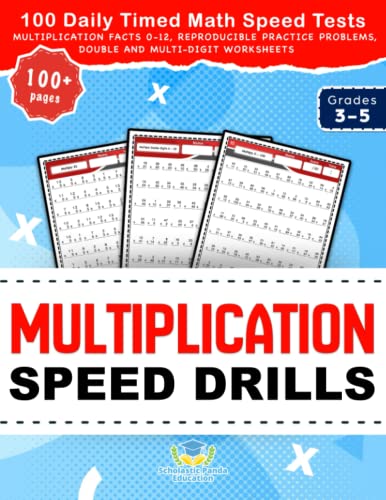
Multiplication Speed Drills
Multiplication Speed Drills gives 3rd-5th grade learners a structured 0-12 practice sequence when loose worksheets are too scattered and the adult wants a repeatable routine.
Start with facts that have anchors
Most 3rd graders build confidence fastest when they see that not all facts are equally hard. The 0s, 1s, 2s, 5s, and 10s create anchors. Once those are steady, harder facts feel less like a wall and more like a smaller set to learn.
For example, 6 x 8 can connect to 5 x 8 plus one more group of 8. The child does not need to use that strategy forever, but it gives them a way to recover while recall is forming.
A 15-minute routine for 3rd grade multiplication
- Choose one family. Pick 3s, 4s, 6s, 7s, 8s, or 9s. Do not practice every hard fact at once.
- Preview two anchor facts. Say an easy fact and one target fact aloud, such as 5 x 7 = 35 and 6 x 7 = 42.
- Show one strategy. Use an array, skip-counting bridge, turnaround, or near fact. Keep it brief.
- Complete a short set. Use 10-20 problems before moving to larger pages.
- Correct immediately. Write missed facts correctly and say the related turnaround.
- Record tomorrow’s target. If 7 x 8 and 8 x 7 were missed, those become the first facts tomorrow.
When to use flash cards, worksheets, or a workbook
Flash cards are useful for quick oral recall, but they can become frustrating if every card feels random. Worksheets are useful for written stamina, but loose pages can make it hard to see what has been repeated. A workbook is useful when the adult wants a predictable sequence, repeated practice, and a cleaner way to return to missed facts.
The best choice depends on the use case. A parent doing after-school review may need one short page and immediate correction. A teacher may need a calm morning-work routine. A homeschool family may want a complete sequence that moves from easier facts toward mixed review.
How to introduce timed practice without pressure
Timed practice should not be the first tool. First, let the child complete a small set untimed and accurately. Then add a generous timer only to help focus. The goal is not to prove that the child is fast; the goal is to notice whether known facts are becoming easier to recall.
If the timer causes guessing, reduce the set or remove timing for a few sessions. You can still track progress by counting correct answers, fewer blank pauses, and faster correction of missed facts.
What to do with missed facts
Missed facts are not just wrong answers. They are the most useful data from the page. Circle them, write the correct fact beside the problem, and connect it to a related fact. If the child misses 8 x 6, write 6 x 8 too. If the child misses 7 x 9, connect it to 7 x 10 minus 7.
The next session should begin with yesterday’s misses. That small loop is what turns practice into memorization instead of page completion.
When a 100-fact page makes sense
A 100-fact multiplication page can be useful after smaller sets are mostly accurate. It gives the child stamina practice and shows whether recall holds up when facts are mixed. But if the child still misses many facts in one family, a 100-fact page may simply hide the exact pattern that needs practice.
Use 100 Multiplication Facts Practice: Daily Drill Plan for Grades 3-5 when the learner is ready for larger mixed review. Use Multiplication Timed Tests: How to Use Them Without Math Anxiety if the timer is becoming the main problem.
Common mistakes to avoid
- Starting every day with a full mixed facts page.
- Moving on before yesterday’s missed facts are reviewed.
- Using speed as the only sign of progress.
- Practicing facts without ever connecting them to division or word problems.
- Comparing siblings or classmates instead of tracking the child’s own progress.
Signs the routine is working
Look for practical signals: fewer finger-counting pauses, quicker recovery after a missed fact, more accurate turnarounds, calmer starts, and less guessing on mixed pages. A child may still be slow while the routine is working. Speed usually follows repeated accurate recall.
If accuracy improves but speed does not, stay with the same fact family for another week and use a gentle timer. If speed improves but mistakes increase, remove timing and return to smaller sets.
FAQ
What multiplication facts should a 3rd grader memorize first?
Start with 0s, 1s, 2s, 5s, and 10s, then move into 3s, 4s, 6s, 7s, 8s, and 9s one family at a time.
How often should a 3rd grader practice multiplication facts?
Three to five short sessions per week usually works better than one long session, especially when missed facts are corrected immediately.
Should multiplication fact practice be timed?
Only after the child can complete a small set accurately. Timing should support focus, not create rushing or shutdown.
What if my child keeps forgetting the same facts?
Repeat those facts at the start of the next session, connect them to easier anchor facts, and practice the turnaround pair together.