
Math Fact Fluency
Addition and subtraction timed tests work best for K-2 learners when they are short, familiar, and accuracy-first. Use the timer as a gentle progress check after children understand the facts with objects, drawings, or ten-frames, not as the first way to teach the skill.

Key takeaways
- Use addition and subtraction speed drills after the child understands the fact relationship.
- Match practice to grade and readiness: sums to 5, sums to 10, doubles, make-ten facts, then mixed review.
- Track accuracy, calm starts, and repeated error patterns before tracking speed.
- Move to a workbook when loose worksheets are too scattered to create a repeatable daily routine.
Who this guide is for
This guide is for parents, classroom teachers, tutors, and homeschool families choosing addition and subtraction speed drills for kindergarten, 1st grade, or 2nd grade. It is especially useful when a child understands counting but still hesitates on basic facts during worksheets, word problems, or morning work.
The goal is practical educational support. This page does not diagnose math anxiety, dyscalculia, attention issues, or any learning condition. If a child has persistent distress, school refusal, or major difficulty with number sense, use untimed practice and consider asking the child’s teacher or a qualified learning professional for individualized guidance.
The parent or teacher decision
The useful question is not “Are timed tests good or bad?” The better question is “What should this child practice today, and is timing helping or hurting?” A timer can show that facts are becoming easier. It can also push a young learner into counting faster, guessing, or shutting down.
| Variable | Choose this when | Next step |
|---|---|---|
| Grade fit | The learner is in kindergarten, 1st grade, or 2nd grade. | Keep sessions short and use visual support when needed. |
| Skill gap | Errors cluster around sums to 10, subtraction from 10, doubles, or mixed signs. | Practice one fact family before mixed review. |
| Daily time | You have only a few minutes during morning work or after school. | Use one small page, correct it immediately, and stop. |
| Practice format | Loose printables are hard to repeat or track. | Use a workbook sequence with predictable page order. |
| Confidence level | The child rushes, guesses, cries, or refuses when timed. | Remove the timer and rebuild accuracy first. |
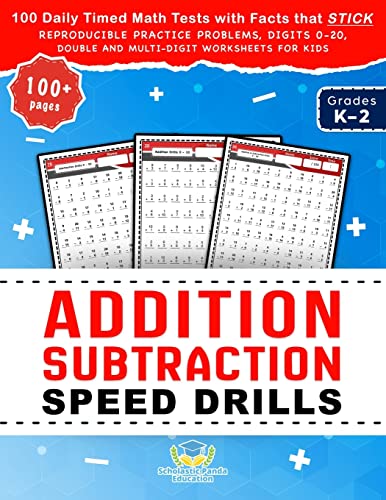
Addition Subtraction Speed Drills
For a repeatable K-2 math facts routine, Addition Subtraction Speed Drills gives families, teachers, and homeschoolers structured addition and subtraction practice without hunting for a new worksheet every day.
What addition and subtraction speed drills should measure
A speed drill should measure smoother recall of facts the child has already practiced. It should not be the first teaching step. Before timing, the child should be able to show a fact with fingers, counters, ten-frames, number lines, or drawings. For example, 8 + 2 should connect to making 10, and 10 – 2 should connect back to the same fact family.
Use the timer to answer one narrow question: “Can this child solve this familiar set more accurately and calmly than last week?” That is more useful than asking whether a young learner can finish a large mixed page as fast as possible.
A calm 8-minute K-2 routine
- Pick one fact target. Choose sums to 5, sums to 10, doubles, near doubles, subtraction within 10, or one mixed review set.
- Preview for one minute. Show two or three examples with counters, a ten-frame, or a number line before independent work begins.
- Practice untimed first. Let the child solve a short row without the timer so the first goal is accuracy.
- Add timing only if it helps. If the child is calm and accurate, use a generous timer for a short round. If timing causes rushing, skip it.
- Correct immediately. Review missed facts while the page is fresh. Ask the child to show one missed fact with a drawing or object.
- Record one note. Write the target, number correct, and one fact to revisit tomorrow.
Grade-by-grade starting points
| Level | Good first drill target | Wait before timing if… |
|---|---|---|
| Kindergarten | Counting on, sums to 5, and simple take-away stories. | The child still needs to count every object one by one. |
| 1st grade | Sums to 10, doubles, near doubles, and subtraction within 10. | The child cannot explain the fact with fingers, objects, or a ten-frame. |
| 2nd grade | Facts within 20, make-ten strategies, and mixed addition/subtraction signs. | The child mixes up the operation sign or guesses under pressure. |
When to use a workbook instead of loose worksheets
Loose worksheets can work for occasional review, but they often become scattered. A workbook is a better fit when the adult wants predictable page order, enough repetition, and a simple way to see whether the child is improving across several days.
Use a workbook when you want to avoid rebuilding the routine each week. Use a single printable when you only need a one-time check on a specific fact set. If the learner is older and moving into multiplication and division, the next step may be Best Math Fact Fluency Workbooks for Grades 3-5.
How timing can go wrong for young learners
Timing goes wrong when the child starts reading the page as a public score or a race. Warning signs include random guessing, skipped problems, tears, stomachaches before math, or saying “I am bad at math” before the page begins. In those cases, keep the same facts but change the conditions.
Turn the timer face down, count correct answers after the page, or ask the child to beat yesterday’s accuracy instead of yesterday’s time. The routine should teach that practice makes facts clearer, not that every page is a pass-fail event.
Common mistakes to avoid
- Starting with a full mixed page before one fact family is steady.
- Timing a child who still needs manipulatives for most facts.
- Moving to harder facts before missed facts are corrected.
- Measuring only speed instead of accuracy, confidence, and error patterns.
- Using speed drills as the only math practice instead of combining them with number sense and word problems.
Signs the routine is working
Look for small, practical signals: fewer blank pauses, fewer counting-all moments, more accurate first attempts, calmer starts, and quicker corrections. A child may still be slow while the routine is working. Speed usually follows repeated accurate recall.
If accuracy improves but speed does not, keep the same fact target for another week. If speed improves but mistakes increase, slow the routine down and return to untimed correction work.
Questions to ask before the next page
- Which fact target caused the most missed answers today?
- Did the timer improve focus or create rushing?
- Would tomorrow’s practice be better as counters, a ten-frame page, untimed review, or a short timed check?
- Does the child need addition recall, subtraction fact families, or mixed-operation switching?
- Is a workbook sequence more useful than finding another printable?
FAQ
When should kids start addition and subtraction timed tests?
Start only after the child can solve a small familiar set accurately without guessing. For many K-2 learners, untimed practice should come first.
How long should addition and subtraction speed drills be?
Keep the full routine to about 5-8 minutes for young learners, including preview, practice, correction, and one note for tomorrow.
Should kindergarten math facts be timed?
Usually not at first. Kindergarten learners often need counting, stories, counters, and ten-frame practice before any timer is useful.
What if timed drills make my child anxious?
Remove the timer, reduce the fact set, and rebuild accuracy first. Add timing back only when the child can complete a short set calmly.