
Math Fact Fluency
Track math facts by recording accuracy, the fact families missed, and the next practice target. Add time only after a learner can complete a small set accurately and calmly.

Key takeaways
- Track accuracy and missed facts before tracking speed.
- Use the record to choose tomorrow’s practice, not to compare children.
- Separate multiplication, division, and mixed-operation results.
- Keep sessions short enough that corrections happen while the work is fresh.
Who should use a math fact tracker?
This guide is for a parent, teacher, tutor, or homeschooler who needs to answer a practical question: should this learner repeat the same fact set, move to a harder set, or step back for more explanation? It works for untimed practice, workbook pages, flash cards, or a short teacher-made set.
The tracker is a planning tool, not a grade, diagnosis, or promise of a particular outcome. If a learner cannot explain what multiplication or division means, use models and instruction before treating recall speed as the main goal.
The five things worth recording
| Field | Example | Decision it supports |
|---|---|---|
| Date | Monday | Shows how often the skill has actually been practiced. |
| Skill | Multiplication 6s | Keeps unlike fact sets from being blended together. |
| Attempted | 20 facts | Gives the accuracy result a clear denominator. |
| Correct | 17 of 20 | Shows whether the set is ready to repeat or advance. |
| Next target | Review 6 x 7, 6 x 8, 6 x 9 | Turns today’s errors into tomorrow’s short plan. |
A 10-minute tracking routine
- Name one target. Choose one operation, fact family, or small mixed set.
- Practice for six minutes. Let the learner work without a timer unless speed is already the planned measure.
- Correct for two minutes. Ask the learner to solve missed facts again and explain one useful connection.
- Record for one minute. Write the attempted and correct totals plus the missed facts.
- Choose tomorrow’s target. Repeat the missed family, reduce the set, or advance only when the work is accurate.
Three examples of the decision
| What the tracker shows | What to do next |
|---|---|
| 18 of 20 multiplication 4s correct; the same two facts were missed twice. | Repeat a smaller set centered on those two facts, then return to the full set. |
| 10 of 20 division facts correct, with long pauses and guesses. | Remove timing and connect each quotient to its related multiplication fact. |
| 19 of 20 multiplication facts and 18 of 20 division facts correct separately. | Try a short mixed-operation set and track sign-reading errors separately. |
When to track time
Time is useful only when it answers a real question, such as whether accurate recall is becoming smoother. Record time after the learner understands the operation and can complete the fact set with few errors. If a countdown lowers accuracy or causes distress, remove it and keep tracking accuracy and missed families.
Do not compare times from different page lengths or different operations. A 20-problem multiplication set and a 50-problem mixed set are not equivalent measures.
Choosing practice from the record
Use the tracker to match the next resource to the bottleneck. If multiplication recall is still uneven, use the multiplication accuracy-first routine. If multiplication is steady but quotients are slow, use the division accuracy guide. Move to mixed multiplication and division practice only when both operations are accurate separately.
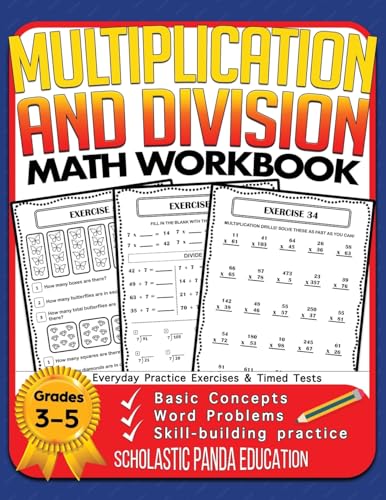
Multiplication and Division Math Workbook for 3rd 4th 5th Grades
Consider this mixed-practice workbook when the tracker shows that multiplication and division are accurate separately and the learner is ready to practice switching operations.
Use, adapt, or wait?
- Use the tracker when an adult needs a simple record for choosing the next fact set.
- Adapt it by removing time, shrinking the set, or tracking only one fact family.
- Wait on fluency tracking when the learner needs instruction on the operation itself or cannot solve the facts with a model.
FAQ
What should a math fact tracker include?
Record the date, skill or fact family, number attempted, number correct, and the next practice target.
Should parents track speed or accuracy first?
Track accuracy and missed facts first. Add time only after the learner understands the operation and can complete a small set calmly.
How often should math facts be tracked?
One brief entry after each practice session is enough. The record should help choose the next target without adding a second assignment.
When is a learner ready for mixed multiplication and division?
Try a short mixed set after multiplication and division are accurate separately and the learner can read operation signs reliably.