
Math Fact Fluency
Use mixed multiplication and division practice after a learner can solve each operation accurately on its own. For most 4th- and 5th-grade learners, the deciding question is not grade level alone: can the child read the operation sign, recall the related fact, and switch operations without guessing?

Is mixed practice the right next step?
| What you notice | Best next step |
|---|---|
| The learner still counts or guesses on multiplication facts. | Practice multiplication fact families before mixing operations. |
| Multiplication is steady, but division facts are often missed. | Use division-only practice and connect each quotient to a multiplication fact. |
| Both operations are accurate alone, but signs get confused. | Begin short, untimed mixed sets. |
| Mixed sets are accurate and calm. | Add a longer set or a gentle time check, changing only one variable at a time. |
Why switching operations is a separate skill
A page of multiplication facts gives the learner one rule to follow. A mixed page adds a decision before every answer: identify the sign, choose multiplication or division, and then retrieve the fact. A child may know that 7 × 8 = 56 and 56 ÷ 7 = 8, yet still miss a mixed problem by applying the wrong operation.
Mixed practice should therefore be a later step, not the default starting point. It checks whether facts are flexible enough to use in more than one format. It does not replace the earlier work of understanding equal groups, arrays, fact families, and the relationship between multiplication and division.
A 12-minute mixed-facts routine
- Preview for two minutes. Review one related fact family, such as 6 × 7 = 42, 7 × 6 = 42, 42 ÷ 6 = 7, and 42 ÷ 7 = 6.
- Practice for five minutes. Give 10-15 mixed problems. Ask the learner to circle each operation sign before solving during the first few sessions.
- Correct for three minutes. Sort each miss into a fact-recall error, an operation-sign error, or a calculation or copying error.
- Plan for two minutes. Choose one missed fact family for the next session. Stop while the routine is still manageable.
Three practical examples
The sign-switch error: A learner answers 48 ÷ 6 with 54 after seeing a nearby 6 × 9 problem. Have the learner name the operation aloud and write the related multiplication fact, 6 × 8 = 48, before trying division again.
The missing fact family: A learner misses 7 × 8 and 56 ÷ 7. Do not repeat the entire mixed page. Pull out the 7-and-8 fact family for a small targeted set, then reintroduce those facts in tomorrow’s mixed practice.
Accurate but slow work: If the learner completes a short mixed set accurately without stress, record the time as a baseline. Repeat a comparable set later in the week. The goal is smoother recall with accuracy intact, not racing a single page.
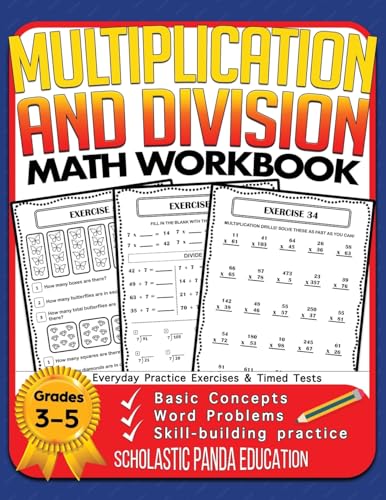
Multiplication and Division Math Workbook for 3rd 4th 5th Grades
Consider this mixed-practice workbook when a grades 3-5 learner is already accurate with multiplication and division separately and needs structured practice switching between the two operations.
Use, adapt, or wait?
- Use mixed practice now when single-operation work is accurate and the main difficulty is noticing or switching signs.
- Adapt it by reducing the number of problems, removing the timer, circling signs, or limiting the set to two related fact families.
- Wait when the learner cannot model the operations, has many single-operation errors, or becomes distressed by the page format.
A workbook can provide a repeatable sequence and reduce the need to assemble loose pages. It should still be paired with explanation and feedback. The verified Scholastic Panda Education catalog confirms the book title and ASIN above; this guide does not claim details about its interior, current price, ratings, availability, or guaranteed outcomes.
How this differs from a workbook comparison
This page answers one narrow question: whether a learner is ready to mix multiplication and division. If you are still deciding between multiplication-only, division-only, and mixed practice, use the math fact fluency workbook guide for grades 3-5. For a multiplication gap, start with the multiplication timed-tests routine. For a division gap, use the division accuracy-before-speed guide.
FAQ
When should 4th or 5th graders start mixed multiplication and division practice?
Start when the learner can solve multiplication and division facts accurately in separate sets and is ready to practice choosing the correct operation.
Should mixed multiplication and division practice be timed?
Begin untimed. Add a gentle time check only after short mixed sets are accurate, calm, and completed without guessing.
What should I do when accuracy drops on mixed facts?
Sort the mistakes by cause, return to the weak fact family or single operation, and try a shorter mixed set in a later session.
How many mixed problems should a learner do at once?
Ten to fifteen problems is a useful starting set. Increase the amount only when the learner stays accurate and can correct errors calmly.