
Multiplication Fluency
Use a multiplication chart as a temporary reasoning tool: help the learner find patterns and derive unfamiliar facts, then cover parts of the chart as recall becomes more reliable.

Key takeaways
- Use the chart to explain relationships, not simply to copy answers.
- Work on one fact family or pattern at a time.
- Move from chart-supported reasoning to recall in small steps.
- Wait on timed tests until the learner can solve the target facts accurately.
When a multiplication chart is the right tool
This guide is for a parent, teacher, tutor, or homeschooler deciding whether a chart will help or merely mask a gap. Use one when the learner can model multiplication as equal groups or arrays but pauses on specific facts. If the learner does not yet understand what 4 × 6 represents, begin with objects, drawings, or repeated addition before emphasizing the chart.
| What you observe | Best next step |
|---|---|
| The learner understands groups but forgets 6s, 7s, or 8s. | Use the chart to connect unfamiliar facts to known facts. |
| The learner copies answers without explaining them. | Narrow the chart to one row and ask for the pattern or related fact. |
| The learner recalls most facts accurately. | Cover known cells and use the chart only for the remaining set. |
| The learner guesses what the multiplication sign means. | Pause chart practice and teach the operation with a visual model. |
An 8-minute chart routine
- Choose one row. Start with a fact family that is useful but not yet steady.
- Notice for two minutes. Read the row and name a pattern, such as every product in the 5s ending in 0 or 5.
- Derive for three minutes. Cover three cells and solve them from nearby known facts.
- Recall for two minutes. Ask the same three facts without the chart, in a different order.
- Record one next step. Note which fact still needs a model or related-fact prompt.
Three ways to derive a difficult fact
| Target fact | Chart connection | Reasoning example |
|---|---|---|
| 6 × 7 | Use a nearby 5s fact. | 5 × 7 is 35; one more group of 7 makes 42. |
| 8 × 6 | Use the commutative pair. | If 6 × 8 is known, 8 × 6 has the same product. |
| 9 × 4 | Use the 10s row. | 10 × 4 is 40; subtract one group of 4 to get 36. |
The goal is not to memorize the explanation word for word. It is to give the learner a dependable route to the answer while recall develops.
How to fade the chart without creating guesswork
Cover only the cells the learner is practicing. Keep nearby rows visible so relationships remain available. When the learner can explain and answer the covered facts accurately across several short sessions, cover a few more. If errors rise, reveal the relevant row again and return to reasoning.
For a simple record of accurate and missed facts, use the math fact tracking guide. When facts are understood and chart support is fading, the accuracy-first multiplication routine explains when timing may be useful.
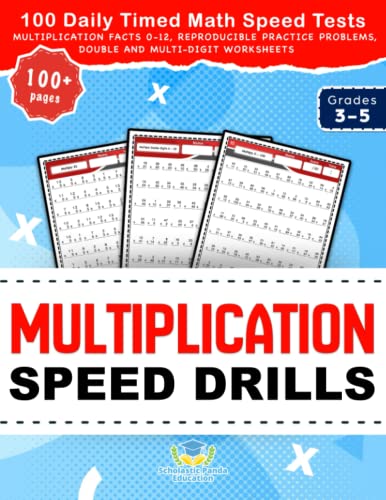
Multiplication Speed Drills
Consider this practice book when the learner understands multiplication and can solve the target facts accurately with little or no chart support; use timing only when it supports calm, accurate practice.
Use, adapt, or wait?
- Use a chart when the learner understands equal groups and needs a visual path to selected products.
- Adapt it by showing one row, highlighting related facts, or covering only a few cells.
- Wait on drills when multiplication meaning is unclear or the learner relies on guessing.
FAQ
Should children memorize a multiplication chart?
The long-term goal is reliable fact recall, but the chart is best used to show patterns and related facts while recall develops.
How long should multiplication-chart practice last?
About 8–10 focused minutes is enough for one row or small fact set. Stop before accuracy or attention drops.
When should a learner stop using the chart?
Fade it gradually when the learner can explain and answer the target facts accurately across several short sessions.
Should multiplication-chart work be timed?
Not while the chart is being used to reason through facts. Consider timing only after the learner understands the operation and answers the target set accurately.