Spelling and Phonics
A useful weekly spelling plan changes the task each day: notice the word pattern on Monday, sort and explain words on Tuesday, write them from memory on Wednesday, use them in context on Thursday, and check only the uncertain words on Friday. For most elementary learners, 10 focused minutes is enough for one session.

Choose the plan that matches the learner
| If the learner… | Emphasize | Adjust the plan |
|---|---|---|
| Can read the words but misspells them | Recall and checking | Spend more time on Wednesday dictation and Friday review. |
| Guesses from the first letter | Sounds and word parts | Say the word slowly, mark the sounds, and compare similar words. |
| Spells the list but not the word in writing | Meaning and context | Use Thursday sentences and a second sentence for uncertain words. |
| Is overwhelmed by a long list | A smaller word set | Practice five to eight words first; add more only after recall is steady. |
A 10-minute Monday-through-Friday spelling routine
Monday: read, notice, and group
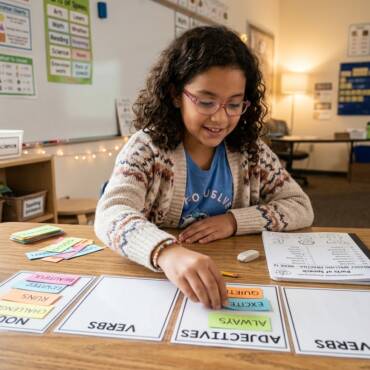
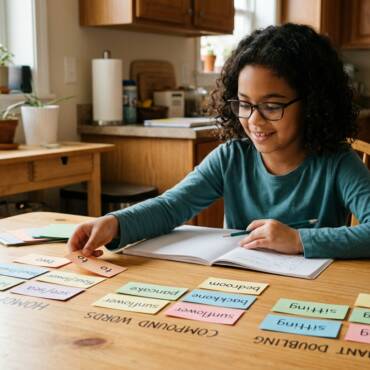
Read each word aloud together. Ask the learner to circle or say the part that may be tricky. Then make two or three groups based on something visible or audible: the same vowel pattern, the same ending, a doubled consonant, or words that do not fit the main pattern.
For example, a list containing rain, train, play, stay, said can become an ai group, an ay group, and the word said as the exception. The goal is not to name a formal rule; it is to give the learner something specific to notice.
Tuesday: sort without looking
Mix the words and ask the learner to rebuild Monday’s groups. Have them explain one choice: “I put train with rain because both use ai.” If a word is misplaced, compare it with one correct example instead of restarting the whole list.
Wednesday: short dictation and immediate correction
Say five to eight words in a mixed order. The learner writes each word without seeing the list. Check the set right away. For a missed word, show the correct spelling, cover it, and ask the learner to write it once more from memory. One accurate correction is more useful than filling a line with unchecked copies.
Thursday: use words in meaningful sentences
Choose three to five words, especially any that were uncertain on Wednesday. Ask for a short sentence that makes the word’s meaning clear. A sentence such as “The train came after the rain” gives two pattern words a real job. Supply a sentence orally if composing and spelling at the same time is too demanding.
Friday: review what is still uncertain
Start with the missed words, not the entire list. Say each word, use it in a sentence if needed, and ask the learner to write it. Stop after a short check. If a word is still difficult, carry it into next week’s first practice set instead of turning Friday into a long second test.
How to correct a spelling mistake
Make the correction point to the part that changed. If the target is stopping and the learner writes stoping, compare stop with stopping and mark the doubled p. If the target is played and the learner writes plaed, return to the base word play before adding -ed. The correction should help the learner reconstruct the word, not merely reveal a score.
When a workbook helps
A workbook can be useful when a parent or teacher wants an organized sequence and repeatable independent practice. Choose by current grade-level fit and the kind of work needed, not by the promise of finishing a certain number of pages.
- First and second grade: begin with the first/second-grade workbook fit guide.
- A learner who needs another early-elementary sequence: compare the Volume 2 guide.
- Third grade: use the third-grade spelling workbook guide.
- Fourth grade: use the fourth-grade vocabulary and phonics guide.
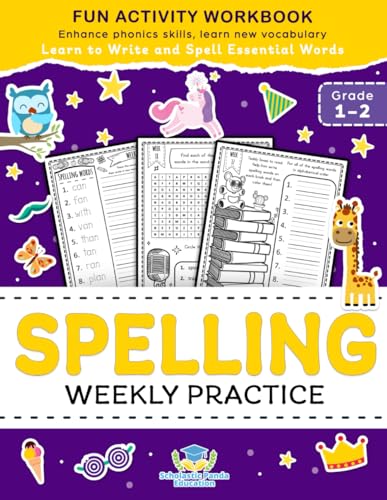
Spelling Weekly Practice for 1st 2nd Grade
Consider this workbook when an early-elementary learner needs a structured weekly spelling sequence. Check the fit guide above first if you are deciding between levels.
Use, adapt, or wait?
- Use the full routine when the learner can read most of the list and write a short set without becoming fatigued.
- Adapt it when handwriting or attention makes a full list difficult. Use fewer words, magnetic letters, oral sorting, or adult-written sentences with one blank for the target word.
- Wait on harder lists when the learner cannot yet hear or read the main word pattern. Practice a smaller set with direct instruction before adding independent homework.
FAQ
How long should spelling homework take each night?
Start with about 10 focused minutes. A smaller completed set with immediate feedback is usually more manageable than continuing until every word has been copied several times.
Should a child copy every spelling word?
Copying once can help a learner inspect a word, but it does not show whether the spelling can be recalled. Include at least one brief task in which the learner writes without seeing the list.
What should happen after a word is misspelled?
Compare the attempt with the correct word, point out the changed sound or letter pattern, cover the model, and have the learner try the word again from memory.
Should known words stay in the weekly review?
Use known words occasionally for a quick check, but give most practice time to uncertain words and the current spelling pattern.